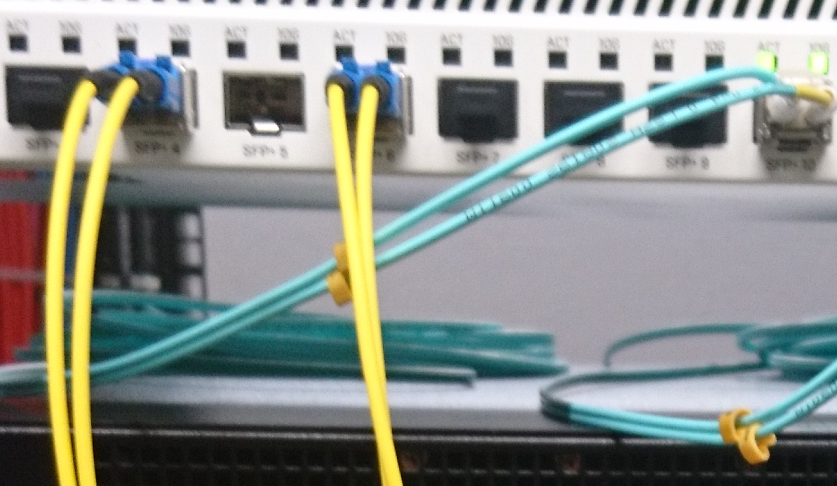
Die Grundlagen aus dem Bereich Rechnernetze werden vermittelt: Schichtenmodelle (TCP/IP und OSI) und die Aufgaben sowie die allgemeine Funktionsweise von Diensten und Netzprotokollen. Die Architektur des Internet und die Funktionsweise und Einsatzmöglichkeiten relevanter Netzfunktionen werden ausführlich behandelt. Anhand der TCP/IP-Protokollfamilie werden die Wegewahl und Weiterleitung von Paketen sowie die Transportprotokolle TCP und UDP vertiefend behandelt. Darüber hinaus werden wesentliche Fragestellungen der Netzsicherheit und des Netzmanagements erläutert. Spezielle Netztechnologien wie z. B. Multicast-Routing, QUIC, VLAN und Funknetze werden anhand von Beispielen betrachtet.
Empfohlene Literatur:
Kurose, James; Ross, Keith: Computernetzwerke, 6. Auflage, Pearson, 2014
Tanenbaum, Andrew S.; Feamster, Nick; Wetherall, J.: Computer Networks, 6. Auflage, Pearson, 2021.
- Dozent/in: Olaf Bergmann
- Trainer/in: René Fokken
Programmieren 3 für Elektrotechnik
WS 2024 / 2025
- Dozent/in: Olaf Bergmann
- Dozent/in: Behrend Pupkes
Course Overview
In implementing Industrial Cyber Physical Systems, the aim is to create an optimal overall package by leveraging existing technological and economic potential through a systematic innovation process, with focus on the following overarching aspects: (i) Horizontal data, information and functional integration through value networks, (ii) End-to-end digital integration of engineering across the entire value chain and (iii) Vertical integration and networked CPS systems. Behind these different Integration aspects are two major structural and behavioural specifications that have to be addressed: structural connectivity and functional/behavioural interoperability between ICPS; that is, ICPS structures are not fixed and predefined. The students will learn how to use the prevalent data and information transport technology and IT configuration rules to automatically build a specific structure (topology) for every situation, including all the associated requirements in terms of models, data, communication, semantic and algorithms.
In order to deliver integration, it is essential to ensure end-to-end digital integration of actuator and sensor signals across different levels right up to the upper levels of an enterprise. It is also necessary to develop modularization and reuse strategies in order to enable ad hoc networking and reconfigurability of ICPS systems, together with the appropriate smart system capability descriptions. Moreover, foremen, operators and MII-students need to be trained to understand the impact of the emergent data transport technologies on the operation of real industrial applications of ICPS.
Basic concepts and an overview of technologies that are used to perform data and information exchange between ICPS-components will be studied, such as:
- Service-oriented Architecture (SOAP, REST)
- Message Broker (MQTT)
- (Other) IoT protocols (ZigBee, LoraWAN, CoAP)
- Modern industrial communication (IIoT) protocols (OPC UA)
In a complementary way to the contents of the ICPS-module, the students will learn, with emphasis in industrial use cases, the specifications and major characteristics of technologies used in the 4 first digitalization layers of the RAMI4.0.
Course Schedule
- Lecture (Prof. Dr.-Ing. Dirk Kutscher): Wednesdays, 10:00am - 11:30am (starting 2nd March 22)
- Practical Exercises (Jeffrey Wermann, M.Eng.): Tuesdays, 3:45pm - 5:15pm (starting 8th March 22)
- Dozent/in: Olaf Bergmann
- Dozent/in: Jeffrey Wermann
Course Overview
In implementing Industrial Cyber Physical Systems, the aim is to create an optimal overall package by leveraging existing technological and economic potential through a systematic innovation process, with focus on the following overarching aspects: (i) Horizontal data, information and functional integration through value networks, (ii) End-to-end digital integration of engineering across the entire value chain and (iii) Vertical integration and networked CPS systems. Behind these different Integration aspects are two major structural and behavioural specifications that have to be addressed: structural connectivity and functional/behavioural interoperability between ICPS; that is, ICPS structures are not fixed and predefined. The students will learn how to use the prevalent data and information transport technology and IT configuration rules to automatically build a specific structure (topology) for every situation, including all the associated requirements in terms of models, data, communication, semantic and algorithms.
In order to deliver integration, it is essential to ensure end-to-end digital integration of actuator and sensor signals across different levels right up to the upper levels of an enterprise. It is also necessary to develop modularization and reuse strategies in order to enable ad hoc networking and reconfigurability of ICPS systems, together with the appropriate smart system capability descriptions. Moreover, foremen, operators and MII-students need to be trained to understand the impact of the emergent data transport technologies on the operation of real industrial applications of ICPS.
Basic concepts and an overview of technologies that are used to perform data and information exchange between ICPS-components will be studied, such as:
- Service-oriented Architecture (SOAP, REST)
- Message Broker (MQTT)
- (Other) IoT protocols (ZigBee, LoraWAN, CoAP)
- Modern industrial communication (IIoT) protocols (OPC UA)
In a complementary way to the contents of the ICPS-module, the students will learn, with emphasis in industrial use cases, the specifications and major characteristics of technologies used in the 4 first digitalization layers of the RAMI4.0.
Course Schedule
- Lecture (Prof. Dr.-Ing. Dirk Kutscher): Wednesdays, 10:00am - 11:30am (starting 2nd March 22)
- Practical Exercises (Jeffrey Wermann, M.Eng.): Tuesdays, 3:45pm - 5:15pm (starting 8th March 22)
- Dozent/in: Olaf Bergmann
- Dozent/in: Jeffrey Wermann
- Dozent/in: Olaf Bergmann
- Dozent/in: Dirk Kutscher
- Dozent/in: Josina Musters