Rationale of the Course:
The rapid advances in computational power, communication and storage coupled with the benefits of the edge, the cloud and services, have the potential to give rise to a new generation of industrial systems whose communication features are based on Industrial-Internet-Technology (IoT), whose functionalities reside on-device (edge) and/or in-cloud and are exposed and/or consumed as micro-services based on the application of the Industrial-Internet-of-Services (IoS) paradigm, resulting to the formation of Industrial Cyber-Physical Systems (ICPS).
The same trend is evident also in other domains e.g., Energy, Healthcare, Transportation, Robotics, Smart Cities etc.. ICPS are the backbone, the enabler of industrial digitalization, connectivity, composability and interoperability between those seemingly disparate domains and application sectors. Since ICPS are real-world networked industrial infrastructures having a cyber-representation through digitalization of data and information across the enterprise and the whole value chain, students will be qualified to understand and work with standards industrial frameworks covering “digitalization of industrial systems based on the ICPS technologies“.
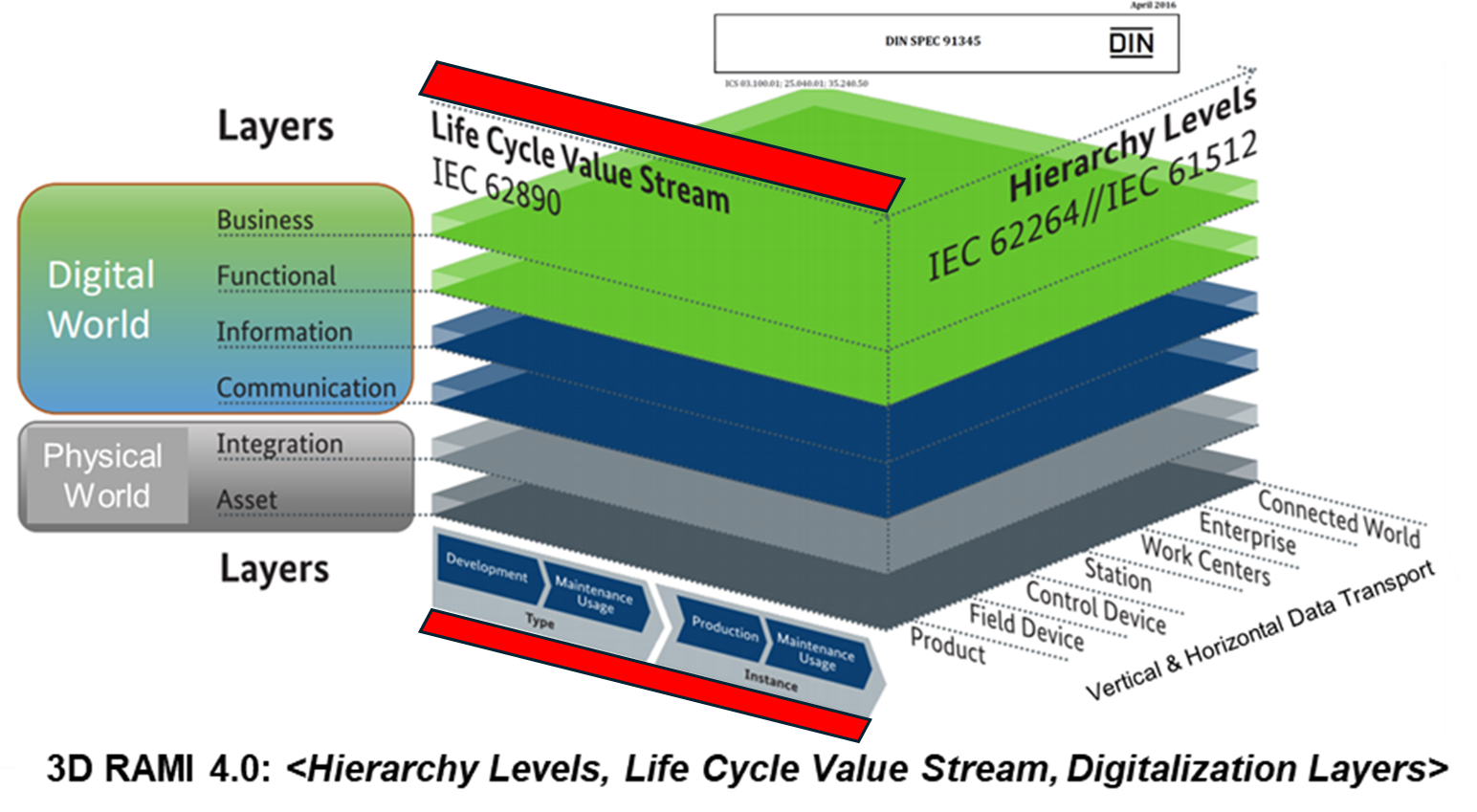
Major topics to be learned in this module: A set of technologies and architectural patterns to enable the specification, implementation and operation of industrial cyber-physical systems under the DIN SPEC 91345:2016-04 (RAMI4.0: Reference Architecture Model for Industry 4.0), the Industrial Internet-Reference Architecture (IIRA), the ArrowHead Framework, the Smart Grid Architecture Model (SGAM) standards will be a core part of the lecture´s contents. In this context, the major specifications of the (i) enterprise standard architectures PERA, ISA´88, ISA´95 (IEC 61512, IEC 62264), (ii) Life Cycle and Value Stream (IEC 62890) and (iii) OPC-Unified Architecture, will be presented and discussed, complemented with studies and analysis (technology and trend screening) of currently implemented industrial solutions for ICPS, performed by the students.
Preliminary Program:
1.1 Industrial Cyber-Physical Systems and Industry 4.0.
1.2 The 3 Dimensions of RAMI4.0. Learning how to navigate the 3D-Model
1.3 RAMI4.0: Hierarchy Dimension / IEC 62264, IEC 61512.
1.4 Curriculum MII-ICPS in front of Industrial Specifications
2.1 Becoming an Architect.
2.2 Production Paradigms. Flexible and Reconfigurable Systems. Mass Production, Mass Customization, Extrem Customization.
2.3 Flexibility, Reconfigurability
3.1 IEC 62264 (ISA´95), IEC 61512 (ISA`88), Purdue Enterprise Reference Architecture (PERA)
3.2 Computer Integrated Manufacturing (CIM)
3.3 Manufacturing Execution System (MES), Manufacturing Operational Model (MOM)
3.4 Vertical and Horizontal Connectivity. The Edge OT/IT
3.5 Collaborative Manufacturing Model (CMM)
4.1
The DIN
SPEC 91345 RAMI 4.0
4.2 Introduction to the Industrial Internet-of-Things, Industrial Internet Architecture (IIA), IIOT
4.3 Introduction to the Alliance of the Internet-of-Things-Innovation High-Level-Architecture (AITOI)
4.4 Introduction to the Smart Grid Reference Architecture (SGAM)
4.5 Introduction to the Eclipse ArrowHead Framework
5.1 Eco-Systems of Digitalized THINGS / ASSETS. The Human in an Industry 4.0-Context: Industry 5.0
5.2 Examples of ICPS, Industrial Architectures and Solutions: Bosch Connected Industry Program, Schneider Electric EcoStruxure, Advantech WISE-PaaS, etc.
- Dozent/in: Armando Walter Colombo
Rationale of the Course:
Following the Specifications modelled by the 3D Reference Architecture Model for Industrie 4.0 (RAMI 4.0) or equivalents (i) Industrial Internet Reference Architecture (IIRA / Industrial-Internet-of-Things), (ii) Smart Grid Architecture Model (SGAM), the contents of this module of the Master Industrial Informatics cover specifically the Value-Stream and Lifecycle Dimension of Industrial Cyber-Physical Systems (ICPS).
Complementing the set of topics learned in the sub-module "ICPS and Industry 4.0" and "Digitalization of ICPS", which are covering the other two dimensions of the RAMI 4.0 specification, the participants of this curse will access background knowledge associated to the standard IEC 62890, covering mainly four major aspects: Lifecycle Engineering of Assets / Things, Engineering Systems-of-Cyber-Physical-Systems, Digital Thread (Life Cycle of Digitalized Data associated to the Life Cycle of Assets/things, and Understanding Evolvability and Emergency in Industrial Systems-of-Cyber-Physical-Systems.
- Dozent/in: Armando Walter Colombo
Welcome to the MII - Course "Digitalization of ICPS", SS2025
- Dozent/in: Armando Walter Colombo